Understanding identity
Students recognize that identity (race, culture, religion, upbringing) shapes how people see the world and how they respond to authority. Identity awareness is essential for fair and effective justice work.
Hands-on learning
What our students actually build, run, and present during Criminal Justice I and II.
Past project · Sept 7 – 15
Circle Talk is the foundational experience of our Criminal Justice program. Before students learn laws, procedures, or casework, they learn people: their identities, cultures, norms, and lived experiences. Criminal Justice is a human system, and every interaction in the field is shaped by communication, perception, and background.
Circle Talk creates a structured space where students share who they are, where they come from, and how their cultural norms influence the way they interpret authority, conflict, respect, and safety. This conversation builds empathy, strengthens classroom community, and prepares future CJ professionals to interact with diverse communities with professionalism and awareness.
Students recognize that identity (race, culture, religion, upbringing) shapes how people see the world and how they respond to authority. Identity awareness is essential for fair and effective justice work.
Eye contact, tone, personal space, and communication styles differ across cultures. Misreading these norms can escalate encounters. Cultural competence improves officer safety and community trust.
Students learn how implicit bias and historical bias influence perception. Recognizing bias is a core part of CJ professionalism.
Historical trauma and lived experiences shape how communities view law enforcement. Understanding these experiences helps future CJ professionals build trust and reduce fear.
Tone, volume, posture, and emotion can be interpreted differently depending on cultural background. Effective communication is one of the most powerful tools in Criminal Justice.
Circle Talk reinforces that justice is not only about laws, it's about human interaction. Students leave with a deeper understanding of how respect, empathy, and awareness shape safer, more ethical CJ encounters.
Circle Talk is more than an activity. It is the foundation of our Criminal Justice program. It prepares students to think critically, communicate professionally, and approach every interaction with cultural intelligence. This project reflects our commitment to building future CJ professionals who understand that justice begins with humanity.
Criminal Justice II · Semester project
An experiential learning initiative in wildlife law, public safety, and conservation
The Criminal Justice II Zoo Research Project is a semester-long experiential learning initiative that immerses students in the real-world intersection of law enforcement, wildlife protection, public safety, and conservation. Grounded in Virginia CTE standards for the Law, Public Safety, Corrections, and Security career cluster, the project blends classroom instruction with authentic fieldwork at a zoological facility.
Students engage in structured research, collaborative team roles, and on-site investigation to explore how criminal justice principles operate in a non-traditional environment. Through direct interaction with zoo police officers and staff, students examine jurisdiction, incident response, security infrastructure, and federal wildlife legislation such as the Endangered Species Act, the Lacey Act, CITES, and the Animal Welfare Act.
"Students engaged directly with zoo law enforcement officers, observed security systems in operation, and analyzed how federal legislation…manifests at the facility level."
The project emphasizes equity-centered education by ensuring all learners have access to meaningful professional exposure. Students take on specialized roles, allowing them to contribute uniquely to the team while developing career-aligned skills.
On-site observations include animal habitat design, visitor management, emergency protocols, and layered security systems. Students compare zoo security to traditional environments such as courthouses, schools, and large public events, strengthening their analytical and comparative reasoning.
"Students conducted systematic assessments of the zoo's physical security features…This layered approach to security was later compared to security models studied in the classroom."
The experience culminates in research reports, reflection essays, and comparative analyses that demonstrate growth in legal knowledge, investigative skills, teamwork, and professional communication. Many students report discovering new career pathways in wildlife inspection, conservation enforcement, and zoo policing.
This project showcases the Criminal Justice program's commitment to experiential learning, interdisciplinary thinking, and preparing students for diverse careers in law, public safety, and environmental stewardship.
Download the full project report (Word)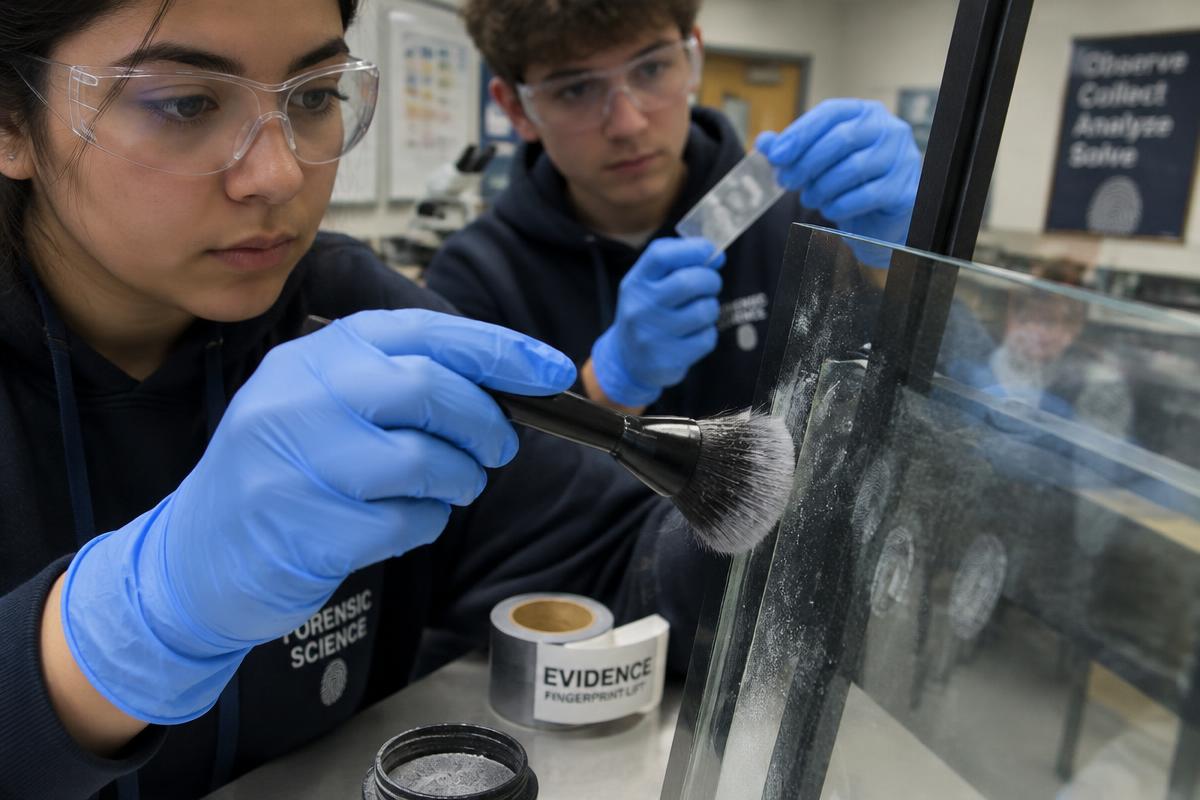
Teams secure a staged scene, photograph and sketch it, collect evidence, and maintain chain of custody from start to courtroom.
Students classify loops, whorls, and arches, lift latent prints, and practice rolling legible inked impressions on FD-258 cards.
Students take roles as attorneys, witnesses, and jurors to run a full criminal trial with rules of evidence and testimony.
Each student builds a portfolio of objective, accurate incident and arrest reports written from scenario video and field notes.
Teams research a local public safety issue and produce a presentation and outreach materials for the school community.
Students research hiring standards, build a resume, and complete mock interviews with agency partners.